
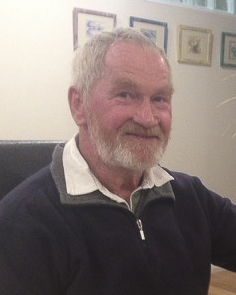
Allen Gilbert
Australian horticultural legend.
The late Allen Gilbert was born in Tongala, just south of the Murray River near Echuca. Alongside a lifelong passion for tennis, his early interests included painting, poetry and horticulture — the latter becoming his career. He continued to write poetry throughout his life. There was also a strong horticultural influence on his mother’s side of the family. His uncle Alan Johnson, a noted Iris and Hippeastrum breeder who lived across the road from the Gilberts, was a major influence on the young Allen.
After completing secondary school, Allen moved to Melbourne to study at Burnley Horticultural College, graduating with a Diploma in Horticulture. He later completed a Certificate in Agricultural Extension at Melbourne University before joining the Victorian Department of Agriculture in the early 1970s. In 1977 he became part of the newly formed Garden Advisory Service, remaining there until it was closed in 1992. Allen then left the Department and pursued a prolific career in horticultural media, becoming one of Australia’s best known and most respected garden communicators, particularly in the areas of fruit trees, vegetables and productive gardening.
I first met Allen Gilbert in 1982 when he was one of the guns at Victoria’s Garden Advisory Service, a State Government agency providing free, top quality gardening advice to the public. (Oh the good old days. They even made house calls!)
As a final year Amenity Horticulture student at Burnley, I was required to answer gardening questions over the phone while Allen and his colleagues listened in and supervised. Allen was formidable. In his no nonsense way he clearly pointed out which answers were insufficient — which I suspect was most of them. I distinctly remember wondering if I could ever know enough to do that sort of work professionally. A few years later, when I found myself answering gardening questions on radio without a safety net, I realised just how valuable Allen’s example and that Garden Advisory Service experience had been.
Allen later became closely associated with Melbourne’s long-running 3CR Gardening Show, beginning in 1984 and managing the program for 15 years. It was a thrill when he invited me onto the show a number of times. He must have forgotten my efforts as a student.
Following the closure of the Garden Advisory Service in the early 1990s, Allen devoted himself fully to horticultural writing and broadcasting. Over subsequent decades he authored 15 gardening books covering subjects including apples, citrus, berries, tomatoes, composting, no-dig gardening, roses, bulbs and climbers. They remain among the most accessible, practical and accurate gardening books produced in Australia in recent decades. Importantly, Allen drew on deep professional knowledge and practical experience rather than simply recycling existing material, as is so often the case in modern garden writing. His earlier books were also at the forefront of making organic and environmentally aware gardening more practical and accessible to home gardeners.
In 1996 Allen and his wife Dr Laurie Cosgrove moved to Adventure Bay on Bruny Island, Tasmania, where they developed a productive and largely self-sufficient lifestyle on a 10 acre property. Allen ran workshops there for many years on sustainability and productive gardening. He also remained deeply involved with heritage orchards, helping restore and advise on important collections including the historic orchard at Rippon Lea and Petty’s Orchard at Warrandyte.
After 18 years in Tasmania, Allen and Laurie returned to Victoria, settling in Ballarat to be closer to family, especially their grandchildren. Allen continued writing and regularly appeared on ABC radio answering gardening questions across western Victoria.
In our horticultural media world, where anyone with an audience can suddenly become an “expert”, there are very few regarded by their peers as the genuine article. The fact is, the people we would genuinely turn to for answers number only a handful. Allen Gilbert is one of them without a shadow of a doubt. He is also a gentleman.
— Rob Pelletier
We are delighted to share a little of Allen Gilbert's horticultural generosity through two outstanding selections: The Gilbert Apple™ and Gilbert Plum™.