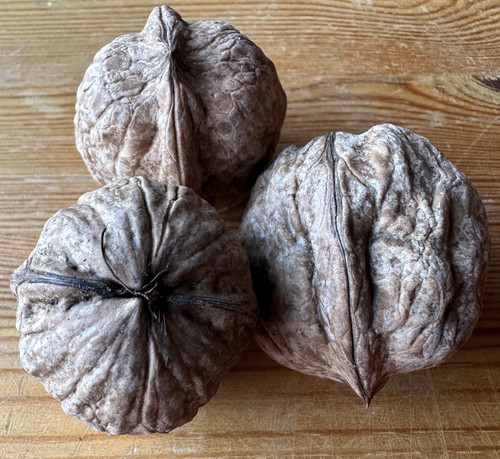


Walnut Kumnic Pride (Juglans regia 'Kumnic Pride') is a rare Australian walnut cultivar recognised by Allen Gilbert in Just Nuts (2005) and grown by respected walnut grower Ian Sluiter near Mildura. According to Ian Sluiter, it produces what he considers the largest nuts in his orchard, with an average-sized crop but the potential for significantly larger individual nuts. It remains an uncommon cultivar with limited published information but is of interest to collectors and walnut enthusiasts.
Check out the book Just Nuts for practical, down-to-earth growing advice tailored to Australian conditions. Need help? Visit our walnut growing guide, care & planting instructions for practical advice, and learn more about pollination.
- Uses: Fresh eating; cooking; baking.
- Pollination: Benefits from cross-pollination with another walnut cultivar.
- Harvest: Information currently limited.
- Chill requirements: Suitable for temperate climates.
- Size: About 10–15 × 10–15 m.
- Attributes: Rare Australian cultivar; capable of producing exceptionally large nuts.
- Features: Large deciduous tree.
- Also known as: Juglans regia 'Kumnick Pride'.
Trees are grown on their own roots propagated from seed, not grafted. Walnuts are one of the few fruit and nut trees that can produce worthwhile trees from seed. Unlike apples, pears and many stone fruits, walnut seedlings are often reasonably similar to their parent, although some variation is still to be expected. Seedling trees typically take longer to bear (around 8-12 years) than grafted cultivars (about 3-5 years), but they develop into vigorous, long-lived trees and have produced many of Australia's finest historic walnuts.
Keep your collection labelled. Add a durable engraved plant label to your order, and order extra labels for existing plants so every tree in your collection stays correctly named.
References incl:
Gilbert, A. (2005). Just Nuts. Hyland House Publishing, Flemington, VIC.
Sluiter, I. (2025, June 12). Personal communication with K. Blood, Glenview Park. Verbal notes transcribed by K. Blood.
Images: Copyright Heritage Fruit Trees