
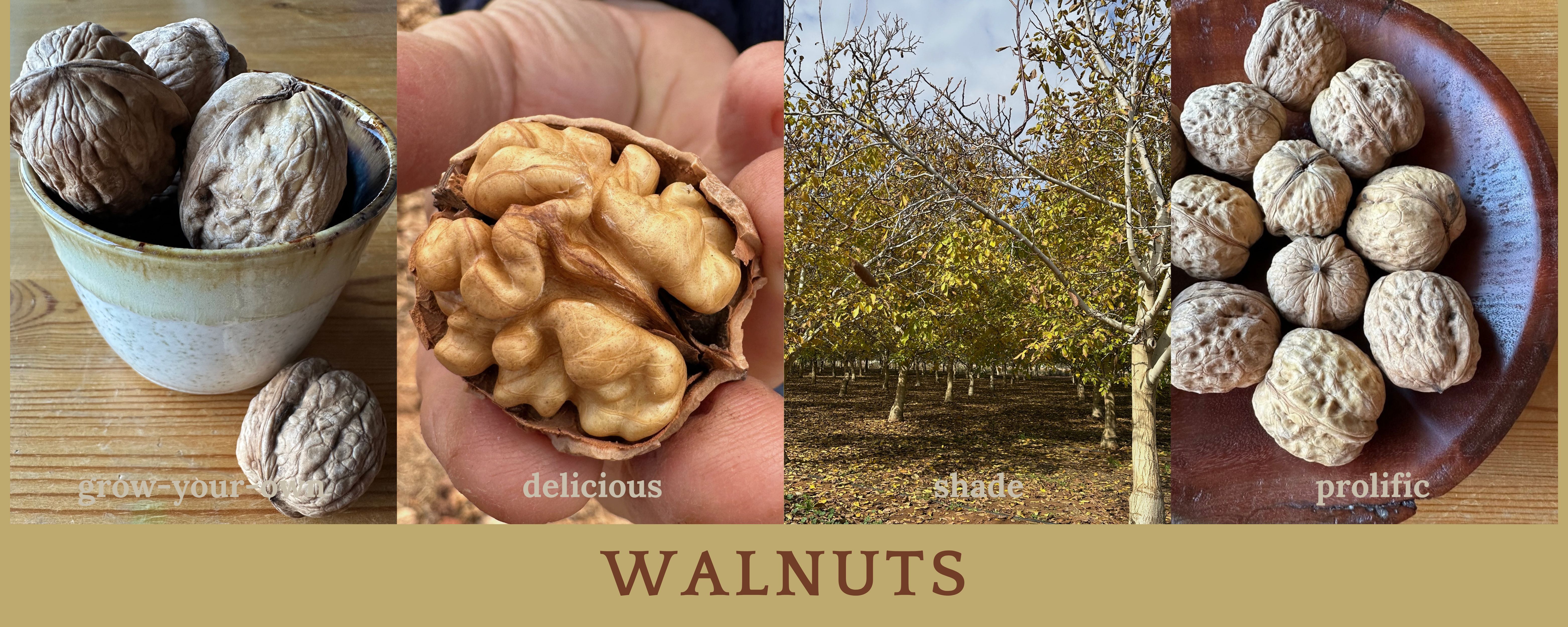
Walnut Growing Guide
Why grow walnuts?
• Grow your own delicious, nutritious nuts that store well for many months.
• Plant a beautiful long-lived shade tree that becomes more productive with age.
• Enjoy one of the world's oldest cultivated food trees with a rich horticultural history.
• Harvest nuts for fresh eating, baking, preserving and making walnut oil.
• Add a valuable specimen tree to larger gardens, orchards and farms.
About walnuts
The English or Persian Walnut (Juglans regia) is the world's most widely cultivated walnut species. Although commonly called the English walnut, it originated naturally across a broad region extending from eastern Europe to the foothills of the Himalayas. From there it spread along ancient trade routes, becoming one of humanity's earliest cultivated food trees. The ancient Greeks even referred to walnuts as the "kingly nut", reflecting the high regard in which they were held.
Walnuts arrived in Australia with early European settlers and gradually proved successful wherever cool winters and suitable soils occurred. Historic walnut trees planted during the early colonial period still survive in parts of Tasmania. Today walnuts are grown commercially throughout many temperate regions of Australia and remain excellent trees for home orchards, rural gardens and larger landscapes. Read more about the history of walnuts in Australia.
Preferred growing conditions
Walnuts grow best in:
• Full sun.
• Deep, fertile, well-drained soils.
• Cool temperate climates.
• Sites protected from prolonged waterlogging.
• Large open areas where the canopy can fully develop.
Walnuts develop extensive root systems and should be planted in their permanent position.
Climate and chill hours
Walnuts perform best where winters are cool and summers are warm and relatively dry.
Most Juglans regia cultivars require about 800 hours of winter chilling for reliable flowering and cropping, although individual cultivars vary. Late spring frosts can damage developing flowers and young shoots, so avoid frost-prone hollows where possible.
In Australia they are generally most successful in:
• cool temperate districts
• elevated inland regions
• areas with reliable winter chilling
Soil
Walnuts prefer:
• deep soils
• fertile loams or clay loams
• excellent drainage
• soil rich in organic matter
• pH about 6.0–7.5
Avoid sites that remain wet during winter, as prolonged waterlogging can damage roots.
Interestingly, mature walnuts can tolerate reasonably heavy soils provided the root zone remains well drained. On heavy clay soils, planting on a raised mound is often beneficial.
Planting
Plant bareroot walnut trees during winter while dormant. See our care & planting instructions for more details.
If planting into heavy clay, create a raised mound to improve drainage during winter.
Allow plenty of room between trees, as mature walnuts develop broad crowns.
Watering
Young trees require regular watering during their first few summers while establishing. Avoid overwatering especially before the leaves have started to grow.
Once established, walnuts become reasonably drought tolerant but crop more reliably if soil moisture remains reasonably consistent throughout spring and summer.
Avoid prolonged waterlogging.
Feeding
Annual additions of compost or well-rotted organic matter help maintain soil fertility and encourage healthy root growth.
Avoid excessive nitrogen fertiliser, which promotes vigorous leafy growth at the expense of nut production.
Mulching
Mulch helps conserve moisture, suppress weeds and improve soil structure.
Apply organic mulch over the root zone.
Keep mulch 5–10 cm clear of the trunk to reduce the risk of collar rot.
Flowering and pollination
Walnuts carry separate male and female flowers on the same tree.
Male flowers are produced in long hanging catkins, while female flowers are small and borne near the tips of young shoots.
Although many walnut cultivars are capable of setting nuts on a single tree, the timing of pollen release and female flower receptivity does not always coincide. For this reason, planting compatible cultivars generally improves pollination and results in larger, more reliable crops. Commercial orchards commonly plant two or more compatible cultivars.
Flowering occurs during spring after budburst.
Pollination partners
| Walnut cultivar | Pollination partner |
| Chandler | Franquette, Fernette |
| Fernette | Used as pollination partner for Chandler |
| Franquette | Used as pollination partner for Chandler & Hartley |
| Hartley | Often no pollination partner used, Franquette |
| Howard | Franquette, Fernette |
| Serr | Pollination partner not recommended |
| Sunland | Tulare |
| Tulare | Often planted with no pollination partner |
| Vina | Chandler, Howard |
Fruiting
Following successful pollination, the green husked fruits develop throughout spring and summer.
Young grafted trees often begin producing nuts after about 3–5 years, while seedlings may take considerably longer.
Nut production increases steadily as trees mature, and healthy trees may remain productive for many decades.
Harvesting
Walnuts are ready to harvest during autumn when:
• green husks begin splitting
• or nuts naturally fall from the tree.
Collect nuts promptly.
Remove the green husks soon after harvest.
Fresh walnuts contain considerable moisture and should be dried carefully in a cool, airy location before storage. Properly dried walnuts can often be stored for a year or more.
Some gardeners also harvest immature green walnuts for making traditional pickled walnuts.
Uses
Walnuts are exceptionally versatile.
The kernels are excellent for:
• fresh eating
• baking
• cakes
• biscuits
• breads
• salads
• savoury cooking
• desserts
• confectionery
Walnut oil is highly regarded for salad dressings and cooking.
Immature green walnuts are traditionally pickled, while the husks have historically been used to produce natural brown dyes.
Walnut timber is internationally prized for high-quality furniture, veneers and fine woodworking.
Pruning
Walnuts require relatively little pruning.
During the first two years:
• establish a strong framework
• encourage good branch structure
• remove damaged or poorly placed shoots.
Carry out structural pruning during early winter, as pruning later in winter or spring can result in excessive sap bleeding.
Mature trees usually require only the removal of dead, damaged or diseased wood.
Avoid removing large limbs unless absolutely necessary. Older neglected trees should be rejuvenated gradually over several seasons rather than heavily pruned all at once.
Pests and diseases
Walnuts are generally hardy trees but may occasionally be affected by:
Walnut blight
The most significant disease of walnuts in Australia.
It affects leaves, catkins, shoots and developing nuts, especially during wet weather.
Good sanitation, pruning out infected wood and timely copper-based sprays (where appropriate) help reduce disease.
Walnut blister mite
Tiny mites cause raised blister-like swellings on leaves.
Severe infestations may reduce tree vigour but are usually manageable.
Codling moth
Developing nuts may occasionally be attacked by codling moth larvae, particularly where apples or pears are also grown.
Good orchard hygiene helps reduce pest pressure.
Birds and rodents may also harvest nuts before gardeners do.
Growing in pots
Walnuts are not recommended for long-term container growing.
Even grafted cultivars develop extensive root systems and are best planted into the ground while young.
Frequently asked questions
How long before a walnut tree bears nuts?
Most grafted trees begin cropping after about 3–5 years, while seedlings may take considerably longer.
Why are our walnut trees seedling-grown?
Unlike many fruit trees, walnuts are often reasonably true to type from seed. Seedling-grown trees have been the foundation of walnut growing in Australia for nearly two centuries and can develop into productive, long-lived trees. They generally take longer to begin cropping than grafted cultivars—often around 8–12 years rather than about 3–5 years—but they represent excellent value for gardeners with the space and patience to grow a tree for future generations.
Unlike many fruit trees, walnuts are often reasonably true to type from seed. Seedling-grown trees have been the foundation of walnut growing in Australia for nearly two centuries and can develop into productive, long-lived trees. They generally take longer to begin cropping than grafted cultivars—often around 8–12 years rather than about 3–5 years—but they represent excellent value for gardeners with the space and patience to grow a tree for future generations.
Do I need two walnut trees?
One tree can produce a worthwhile crop, but planting compatible cultivars usually improves pollination and increases yields.
How big do walnut trees grow?
Seedling trees may eventually exceed 20 metres in favourable conditions, with some capable of becoming considerably larger. They require plenty of space.
Can walnuts be grown in warm climates?
Walnuts require winter chilling and generally perform best in cool temperate districts. Select cultivars suited to your local climate.
Top tips for success
• Plant in full sun.
• Choose deep, well-drained soil.
• Avoid winter waterlogging.
• Plant on a mound if growing in heavy clay.
• Water regularly while trees establish, however, don’t overwater.
• Mulch annually with organic material.
• Prune lightly and only when necessary.
• Plant compatible cultivars for heavier crops.
• Harvest promptly and dry nuts thoroughly before storage.
Further reading
Allen Gilbert's Just Nuts remains one of Australia's most practical references for home nut growers.
Additional information can be found through:
• University of California, Davis Walnut Research Program.
• California Walnut Board.
• State government agriculture departments.
Explore our collection of walnuts.
Get a label with that
Make sure you never mix up your plants! Add an engraved label to your new order—or grab custom-engraved labels if your plants are already in the ground. These durable markers make it easy to remember which plants are where. Happy gardening!
References include:
Gilbert, A. (2005) Just nuts. Hyland House Publishing, Flemington, Australia.
Royal Horticultural Society. (n.d.). Juglans.
University of California, Davis. (n.d.). Walnut Research & Information Center.